
I’ve been searching for playtime; in my quest I have discovered fun requires work. Beyond seeming horribly unfair, why is fun so much work?
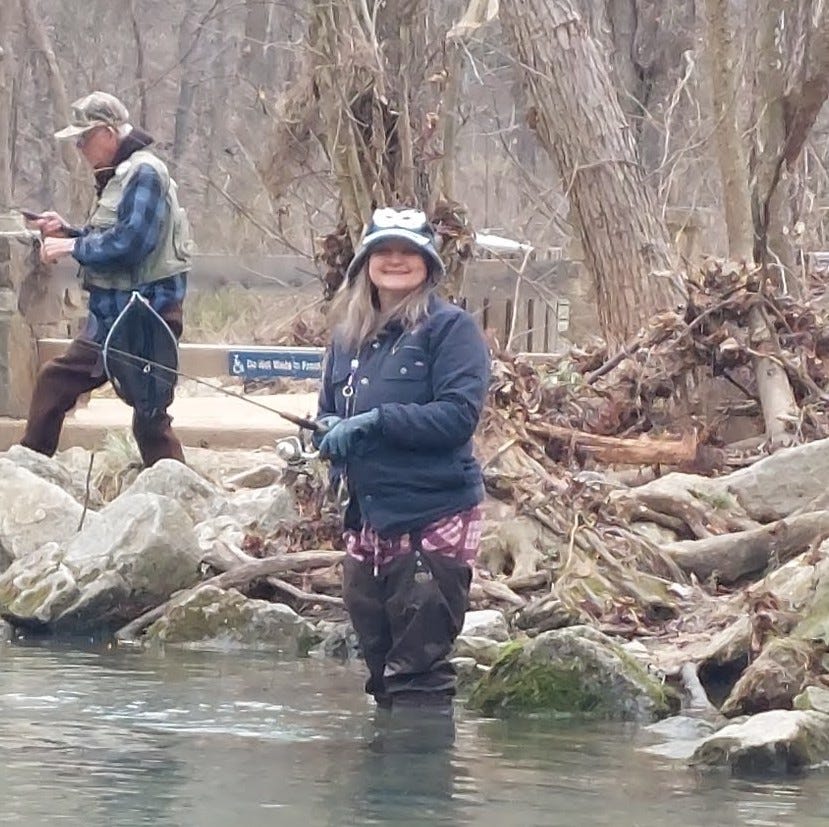
Note about this image: My husband took this on March 19, 2026, during my first-ever attempt to fish for trout in a river. The previous day was my entry into trout fishing by casting from dry ground at the river’s edge.
My Mysterious Mind
It’s spring break and our first-scheduled outing with our new little camper, or at least that was the plan. Today is the day my husband and I were going to head to a state park for a two-night stay. Instead of heading to the campground, we hooked up the camper and took it for service. In doing our final preparations we discovered problems.
We had to wait until today’s above-freezing temperatures to test the water system. The water pump wouldn’t come on. There were several other, minor, issues we discovered. I made a list and called the service department. Everything is under warranty, but a warranty doesn’t preserve camping plans. Our appointment was in 90-minutes.
This “fun” mini-camping trip has already required a bunch of work. I’ve enjoyed equipping the camper with supplies, buying a new skillet and pot for the one-burner induction cooktop, and choosing which towels and such to use. The menu preparation has also been fun; one of the items is in the oven at home now, previously planned for a cast-iron experiment over hot coals. The rest of the menu is “on hold” until we know the status of our portable home.
Spring Break is supposed to be about having fun and recovering from work, but, somehow, fun always seems to require a bunch of work. I marvel at my grandchildren, who can just have fun. In his bedtime prayers, my oldest always tells God, “Thanks that I got to play.” I have fun playing with him, but getting to his house requires a full day of driving, in addition to the schedule-clearing, packing, and other preparations needed.
I know the saying, “all work and now play makes Jack a dull boy,” but what about Jack, as a man, who must work very hard to play? I gave up on playtime years ago, choosing to have fun at work instead of making time to play. But then, I am German, working is what we do best. Playing, not so much.
With only a three-hour delay, our service issues resolved, our maiden voyage began. We arrived in time to set up and build a campfire. With shelter ready for the night, we could grab some sleep before heading out early for trout fishing, one of my husband’s favorite hobbies. As a child, I used to fish for catfish in farm ponds. Graduating from a push-button reel required me to learn how to operate mechanical gismos foreign to me.
I mainly focused on not throwing my husband’s fishing gear into the river, either accidentally or out of frustration. My beginner’s luck included catching a tree, abandoned fishing line, rocks, twigs, and underwater mysteries, but no fish. A “chance” visit of a river otter saved the day from being too much work and not enough fun.
As I recovered in a lawn chair back at our campsite, I pondered the mystery of playtime. Having fun requires some amount of work; in fact, I believe there is a work-to-fun ratio for a successful sense of play. If work exceeds fun, playtime isn’t the outcome. If, however, fun is greater than the work required, playtime is achieved. Granted there is also an idiosyncratic sense of fun for each person, thus, for some activities the level of work can be high and playtime is still experienced.
On the second morning of our camping trip, I decided to try wearing waders and fishing from inside the river. Having mastered the basic complexities of casting and reeling with an unfamiliar rig, the level of work was diminished. Plus, I love water; being in the water was more fun than standing beside it. With fun levels above the required work, the outcome was a sense of play. Did I catch any fish? Well, there was that big one that got away….no, seriously, there was.
Does your life include time to play? In the overall balance of work and fun, which side of the equation is winning? Children naturally know how to play; serious grown-ups, knowing how to work, may have forgotten how to have fun.
Message of Mystery Acres
I love being in our patch of forest. Packing and unpacking are required, as is cooking and cleaning while there, but the fun to work ratio works out well for me on most visits. I have fun taking walks, looking for wildflowers, and finding unusual rocks. On clear nights, I enjoy watching the stars appear and listening to nocturnal creature noises.
There is always the temptation to turn this place of play into a source of work. Driven to improve whatever is in reach of my hands, I am repeatedly at risk of sabotaging the playtime my forest provides. I’m not sure if it’s human nature or it’s my nature, but making ‘to do’ lists and checking things off is a daily activity for me, even at Mystery Acres.
Our recent camping trip didn’t include any objectives. I didn’t prepare a list of tasks, only meal plans. As I sat outside our new camper I was reminded of what my personal bit of forest was intended to be, before my achiever-oriented mind claimed my time there. Camping is supposed to be more about fun and less about work.
The message of Mystery Acres is a nudge to reclaim playtime in the forest, a prompting from another place, a camping trip at a state park. Times of recreation are restorative when fun is greater than the work needed. Fun requires so much work because I made it so, and I can change that.
Ancient Mystery’s Voice
“Jesus said, ‘I came so they [the sheep] can have life to the full.’” (see John 10:10)
The word “fun” does not appear in the Bible; the word “play” only appears in reference to musical instruments except for one verse about children playing (Zechariah 8:5). In contrast, there are over 500 uses of the word “work.”
Is life supposed to be fun? With scriptures such as, “take up your cross and follow Me” and “endure hardship as a good soldier,” it seems as though life is supposed to be hard, even as a follower of Jesus. Or, perhaps, because of being His follower.
I wonder about that original garden, the one before sin’s infection. Adam and Eve were supposed to do gardening, but the sweat and thorns showed up after sin damaged creation. Even today, I have many friends who enjoy gardening, for whom such work is playtime, fun even. Was life more fun and less work before the contamination of sin? It seems likely.
God the Father made a place for His children to live, love, and play. Sure, there was work to do, but it wasn’t unpleasant or frustrating. Sin did that. Is life in a sin-filled place completely devoid of fun?
Recorded in chapter 10, the disciple John wrote about Jesus as the good shepherd for the children of God, the sheep. Buried in this shepherd-sheep metaphor is one of my favorite verses, where Jesus said, “I have come that they might have life and have it to the full” (John 10:10). Viewing this from my grown-up perspective, I thought Jesus might be referring to having joy, but I never considered how Jesus might be talking about having fun.
So, I searched the Internet for information about sheep and having fun. I discovered that sheep farmers are wise to enrich the experiences of sheep, especially lambs, with playtime. In addition to having room to jump and twist their bodies (gamboling), lambs like to play with balls, stuffed animals, sticks, and each other. Thus, if a shepherd wants to provide a full life for lambs, playtime is part of that.
Ancient Mystery’s Voice is the voice of a shepherd, the Good Shepherd, Jesus, announcing the life He desires to provide for those in His care. Jesus came so that we, His sheep, could have a life that is full, including times of play. Cross-carrying is hard work; our Lord provides playtime because He loves His little lambs.
Living in Mystery
What does it mean to live in the mystery of playtime, responding to the question “why is fun so much work?” After starting to write on this topic, I had the uncomfortable realization I may not be the best person to give advice. But here goes anyway!
If playtime results when the fun exceeds the work required, consider the hobbies and recreational activities in your life. Overall, is there more fun than work? If yes, then you are experiencing playtime. If work is greater than fun, you are missing out on the benefits of playing. Consider how you might increase fun and decrease work, at least in the allocation of time dedicated to restoration. What are your hobbies? What do you do for recreation? Examine the ways you might get fun and work in better proportions.
Next, find ways to have more fun while working. I enjoy my job and the people with whom I work. I have often remarked, “If you can’t have fun at work, why bother showing up?” I like being productive; I especially enjoy having fun with other people at the same time as I am getting things done. How can you bring more fun into your job or required duties?
Lastly, ponder if you are more of a serious, worried grownup or a happy, beloved child. The Good Shepherd desires to bring abundance into your life, and that includes joy and fun. How can you cooperate with His dedication to caring and providing for you? Worry less; trust more. Have more fun. He loves His lambs and wants them to play, safe in His protection and provision.
As spring break draws to a close for me, I realize my life needs more playtime. Work is inevitable, even for hobbies and recreational activities, but the balance can be adjusted so a sense of play and restoration is achieved. Life is hard; adjust your playtime by finding more fun and a bit less work.
Connecting with Mystery
Dear Lord of All Mystery, I confess to making life more work than is necessary. Help me to see how You are providing a safe place for me to work and to play. Thank You for coming so that I might have life, and have it abundantly, as Your beloved lamb. Amen.
Notes from Dr. Mac
If you want to do your own investigation of any of the scriptures I use, try Bible Gateway.
Do you want more from my writing? Please visit my ARCHIVE (link and QR code provided).

You can also connect to Mystery’s Voice on Spotify (link provided).
Please pass on this message to friends and suggest they subscribe. It’s free!
I love to find out what you’re thinking! You can email me at: Dear Dr. Mac or leave/send a message (buttons below). I love hearing from you!