
I don’t like dust or the task of removing it. Having heard it’s composed mostly of dead skin cells gives me further justification in my disdain for it. How can I find inspiration for joyous living in dust, a residue of mortality?
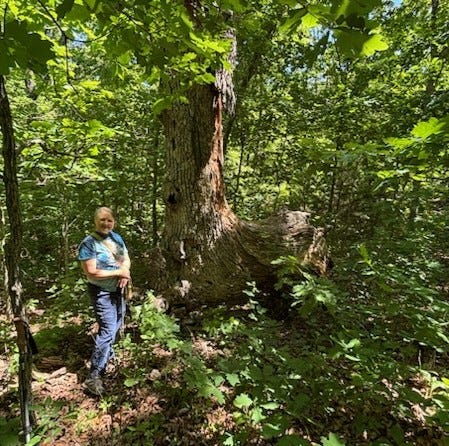
Note about the image: This is Grandfather, May 2026, gradually decaying and feeding the life around him.
My Mysterious Mind
My summer schedule has become less full, with more time to be in my house and less at my office. The anticipation of time to relax, catch up with neglected tasks, and run needed errands has been invaded by a thin layer of an annoying substance on the furniture in view of my relaxing recliner. Dust.
I know this nuisance will return soon after its removal, so why hurry to grab the dusting supplies? Instead, I’ve been thinking about dust while observing its pervasive presence in my home. Having heard dust is mostly dead skin cells, I have also been pondering mortality.
It turns out that “80% of dust is dead skin” is wrong. More accurate estimates are 20-50%. The rest is residue from outside, pets, or deteriorating manmade household furnishings. Let’s just stick with the dead skin portion of dust; the rest is troubling in its chemical and biohazard composition.
According to the Internet, “an average adult sheds roughly 0.03 to 0.09 grams of skin per hour.” Skin cells are continually dying and being replaced, with dead ones sloughed off. Bedroom dust has a higher proportion of dead cells because we spend about a third of our time sleeping. Our bodies are discarding skin cells due to our inherent mortality. Dust is residue of that mortality.
I don’t like dust. Thinking about its composition makes me dislike it more. I’m mortal. My body is shedding evidence of that. The evidence collects as an unattractive coating on everything in my home. Yuck.
Message of Mystery Acres
Having grown up as a farm girl, I have a relaxed attitude about the cleanliness of food. Food is, after all, just recycled dirt. Fruits and vegetables are clearly produced from dirt, combined with water and sunlight. Animals survive by eating what grows from the dirt or eating other animals who survive by eating what grows from the dirt. After an animal or plant dies, the remains become dirt and are recycled by the next generation of plants.
If food isn’t recycled dirt, it’s synthetic and not really food. If food has a little bit of dirt on it, that just skips the middle step of becoming food before being eaten. Don’t worry – I do wash fruits and vegetables before eating them. I don’t feel a need to double or triple wash them.
What does this have to do with Mystery Acres? Natural recycling from dirt to life and back to dirt again is happening constantly in the forest. Fallen trees gradually decompose into dirt; we can watch the process over the years of our visits.
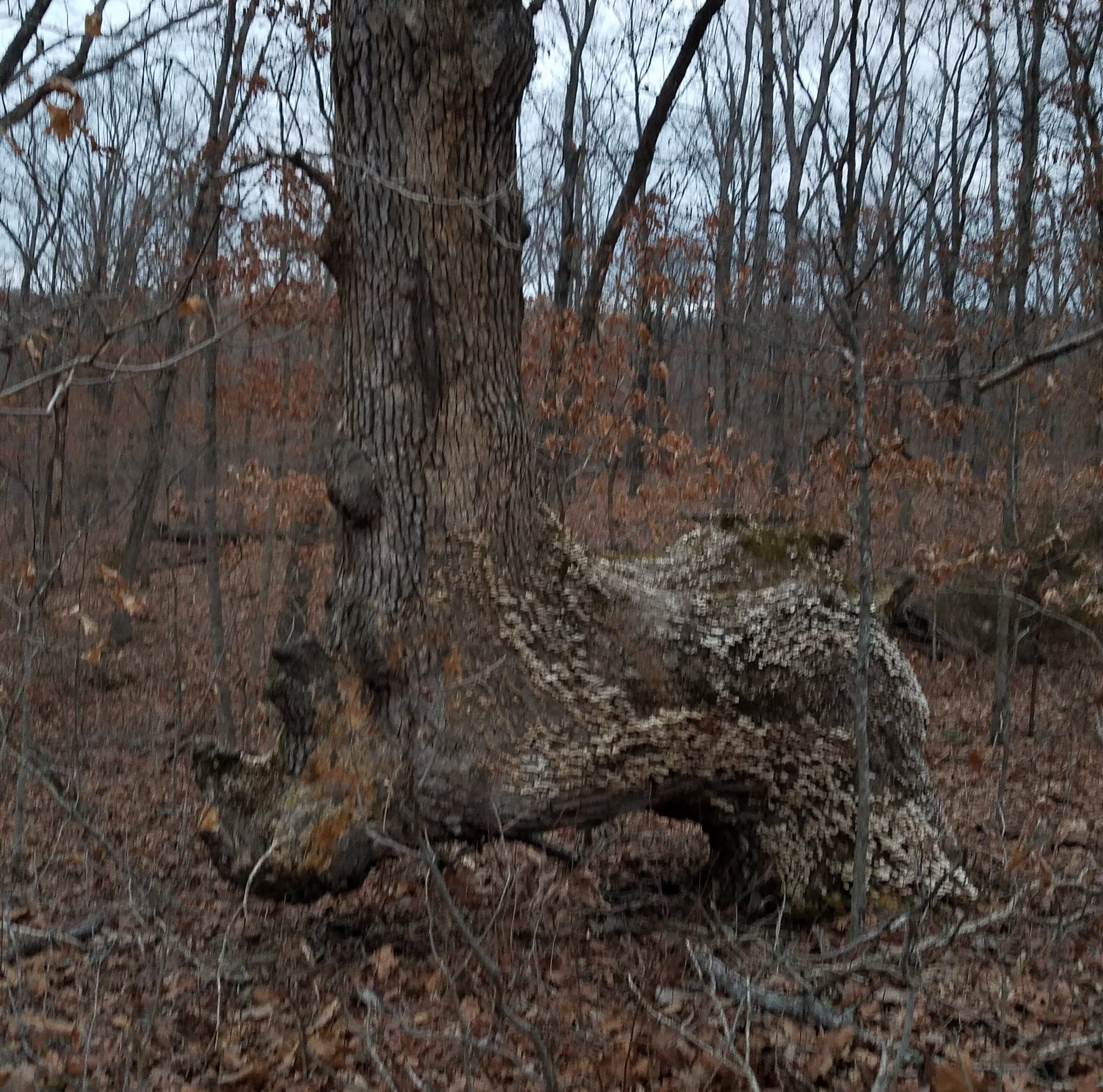
Note about the image. This is Grandfather, already dead, in March 2019, shortly before my husband and I purchased the property. Spring had not yet emerged in the forest.
One of the marker trees, Grandfather, was already dead when we purchased Mystery Acres in 2019. [There’s a picture from 2019 in the post here.] We considered removing the upper branches to reduce the weight on the cantilevered tree but decided to allow natural processes. We expect to find Grandfather collapsed on the ground on some future visit. Until then, I visit him and pay my respects to his gradual return to the dirt from when he grew. A white oak, Grandfather might have been as old as 350 years at the time of his death. The base of the original trunk is almost ten feet in circumference. Or at least it was before the bark started to fall off.
The message of Mystery Acres is about dirt. Like dust, it is residue of mortality, but it also forms the foundation for life. I am sad that my beloved tree, Grandfather, is slowly turning into dirt. At the same time, I find joy in watching life springing up from his decomposition. I wish death wasn’t a necessity for life.
Ancient Mystery’s Voice
“From dust you were made, to dust you shall return.” (Genesis 3:19)
The story of humans is a tale of dust. God formed the first human, Adam, by shaping some dust and breathing life into it. Eve was taken from Adam’s rib, which also originated as dust. These first humans were made of dust but not infected with mortality.
These dust-made humans became “dusty” after they disobeyed their Creator. The words “earth to earth, ashes to ashes, dust to dust” said at many a graveside service, echo the declaration of God as He told Adam and Eve they were taken from dust and to dust they would return. The exact words of the funeral prayer are not in the Bible but are supported by truths found there.
That’s not the whole story. There is a bigger story of love behind the destiny of dust. Life came into humans because God put His breath into them. Death came into dust-made humans by rebellion. Then, two thousand years later, that same God, as Jesus, entered a mortal body made of dust. Jesus lived in that body of dust for 33 years then willingly died for dust-made humans, paying the price for their rejection of God.
A popular Bible verse might appropriately be reworded as:
“For God so loved the [dust] that He gave His Son Jesus to die for the sins of the [dust].”
Jesus humbled Himself to enter a wrapping of mortal dust. Why” Love was the motive, love for humans made of mortal dust. We don’t love dust, but Jesus did, does, enough to die for it.
In another layer of this divine dust story, Jesus, after coming back to life, went back to heaven and sent the Holy Spirit back to those who believe. The Holy Spirit enters our dust-made, still mortal bodies, and sustains us with a new life. God, as the Holy Spirit, dwells in temples of dust, us, as a deposit to guarantee our life with Him after mortal death.
Ancient Mystery’s Voice speaks of a wonderful mystery about dust. I don’t love dust. I especially don’t like it reminding me of the mortality of this body of dust. But God so loved the dust! His love is demonstrated in the first breath of life given into Adam and the return of that breath of life through the Holy Spirit into our still-dusty bodies. Our story doesn’t need to end when these dust-made bodies stop. There is life beyond mortal death, and it isn’t just dirt recycling.
Living in Mystery
What does it mean to live in the mystery of dust, a residue of mortality? It starts with letting dust remind you of your own limited life in your mortal body. As uncomfortable as this may be, living in the knowledge of your finite time can infuse life with greater meaning. Like nature’s recycling program, your life emerges from the sacrifices of others’ lives, and your passing from this life can be the foundation for those who outlive you.
Mortality means time is limited. At some point the clock of your life hits “zero.” The people you love in this life are also on restricted calendars. Today, when you are together, is the currency you have available to invest in relationships. Dust is a reminder of the limit of “todays.” Don’t wait to make amends. Don’t delay telling loved ones how much you value them. Let dust remind you to fully live today.
Spend time in nature and observe the pattern of dust to life to dust to life. Find joy in the sadness of what dies as it lays the foundation for new life to emerge. Let nature teach you about mortality where death transforms into life. There’s a lesson from nature here, but it also speaks to the mystery of bringing spiritual life from death.
Our bodies are made of mortal dust, still dying, but there is life preserved within us beyond mortal death. God’s story of dust proclaims His love for us:
God so loved the dust!
Let dust in this life remind you to imagine a life beyond this one where furniture doesn’t gather dust. In a life beyond this one, our immortal bodies won’t need to shed dead skin cells. I don’t know what that will be like, but the absence of annoying dust is something exciting to me!
For now, I am a temple of dust in which the Spirit of God lives as a deposit for a future time, a time without death. Dust on furniture is a residue of my temporary mortality. Whenever I notice dust and think about how much I dislike it, I can think about the great love my Creator has for dust.
For God so loved the dust, so loved me, so loved you!
Connecting with Mystery
Dear Lord of All Mystery, I don’t like dust. It makes everything look dirty and it reminds me of my mortality. But Your love for dust was so great You found a way to live with Your spirit inside of me, mere temple of dust that I am. Thank You for Your love of me. Help me live in the hope of a life after this one, a life without dust, without this residue of mortality. Amen.
Notes from Dr. Mac
If you want to do your own investigation of any of the scriptures I use, try Bible Gateway. Search for “dust” and ponder the 100 uses of the word.
Do you want more from my writing? Please visit my ARCHIVE (link and QR code provided).

You can also connect to Mystery’s Voice on Spotify (link provided).
Please pass on this message to friends and suggest they subscribe. It’s free!
Let me know what you’re thinking! You can email me at: Dear Dr. Mac or Join the Chat through the button below. I hope to hear from you!